Below, you find an outline of ongoing projects in the group. For an idea of what we have done in the past, please check out our publications
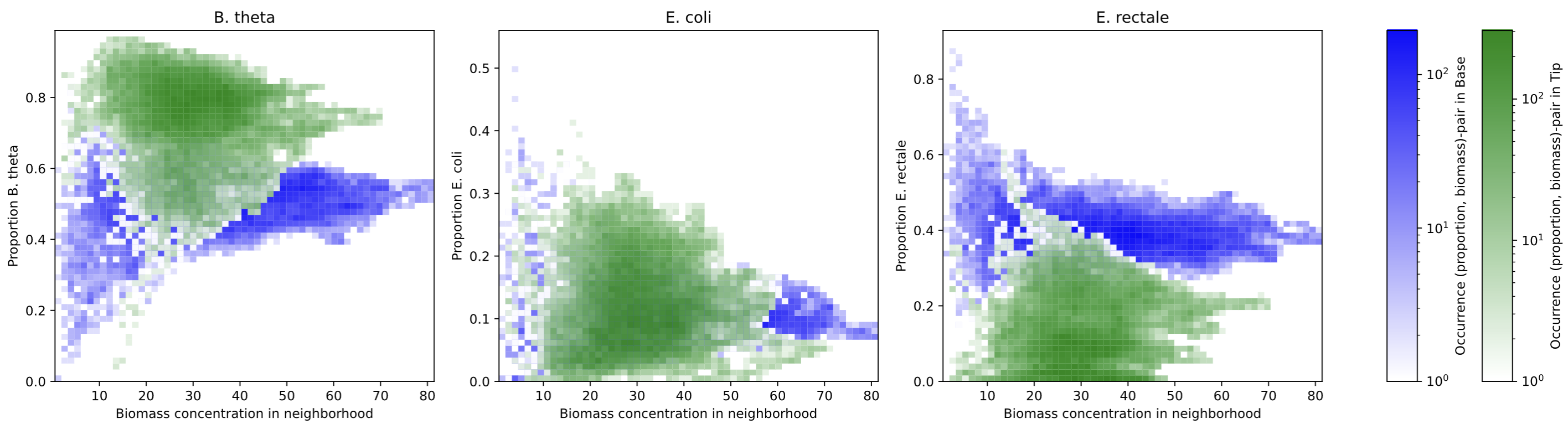
Ecological consequences of emergent spatial structure in the gut microbiota
Based on our recent finding that microbial growth and mixing leads to spatial self-organization of microbes in the gut, we are currently investigating how this influences selection in the gut. We combine a rich dataset on spatial arrangement of microbes and host food intake patterns with mathematical modeling to investigate this. This project is mainly driven by Sebastian Hummel.
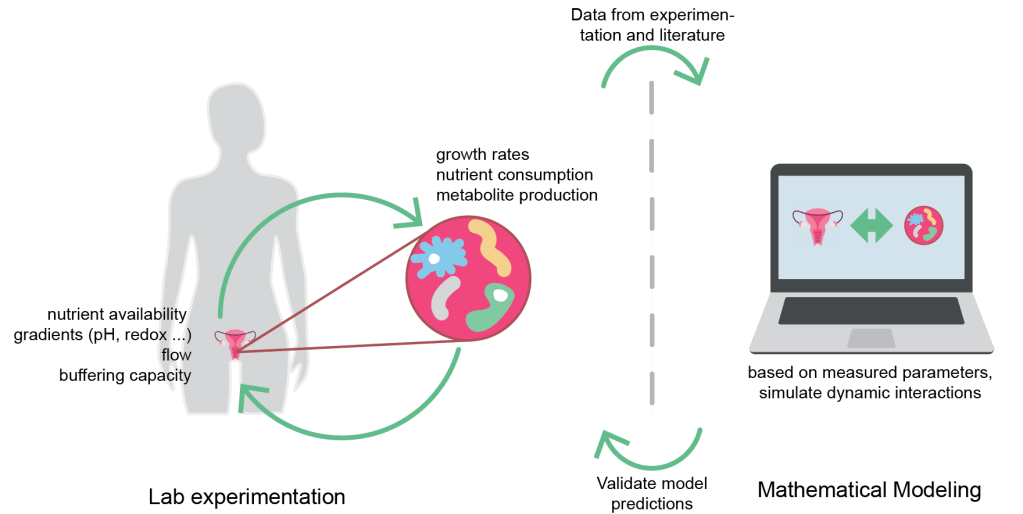
Quantifying physiological interactions between vaginal microbiota and host
The human vaginal microbiota has crucial effects on health. In eubiosis, it is typically dominated by few species of Lactobacillus, but in many women higher diversity and the presence of obligate anaerobes correlate with health problems such as higher susceptibility to STIs and pre-term births. We are investigating how Lactobacillus dominated communities achieve stability, and how disturbances can lead to invasion of anaerobes and dysbiosis. This project is primarily driven by Stella Greuter.
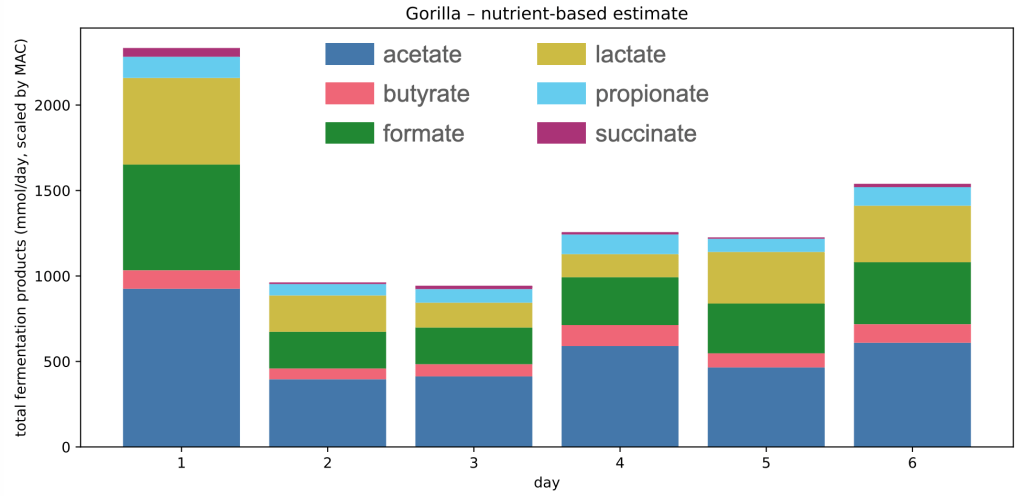
Quantifying the microbial contribution to energy harvest in non-human primates
Building on our work quantifying fermentation products in diverse human populations, we are now trying to understand the differential contribution of diet and evolutionary distance to this effect. To this end, we teamed up with the Zürich Zoo and Anton Lavrinienko at ETH Zürich, to investigate how much Gorillas and Orang Utans depend on their microbes for extracting dietary energy.